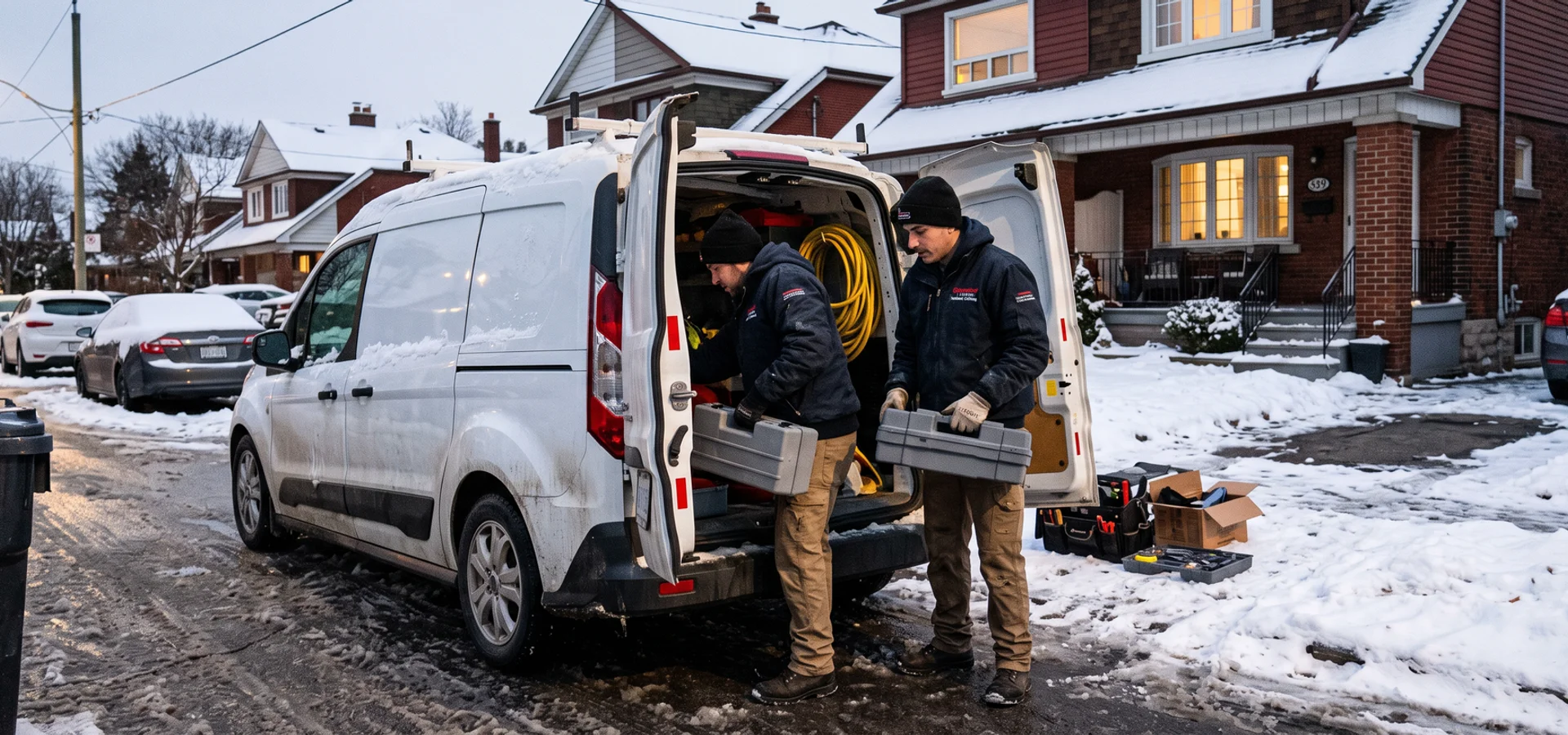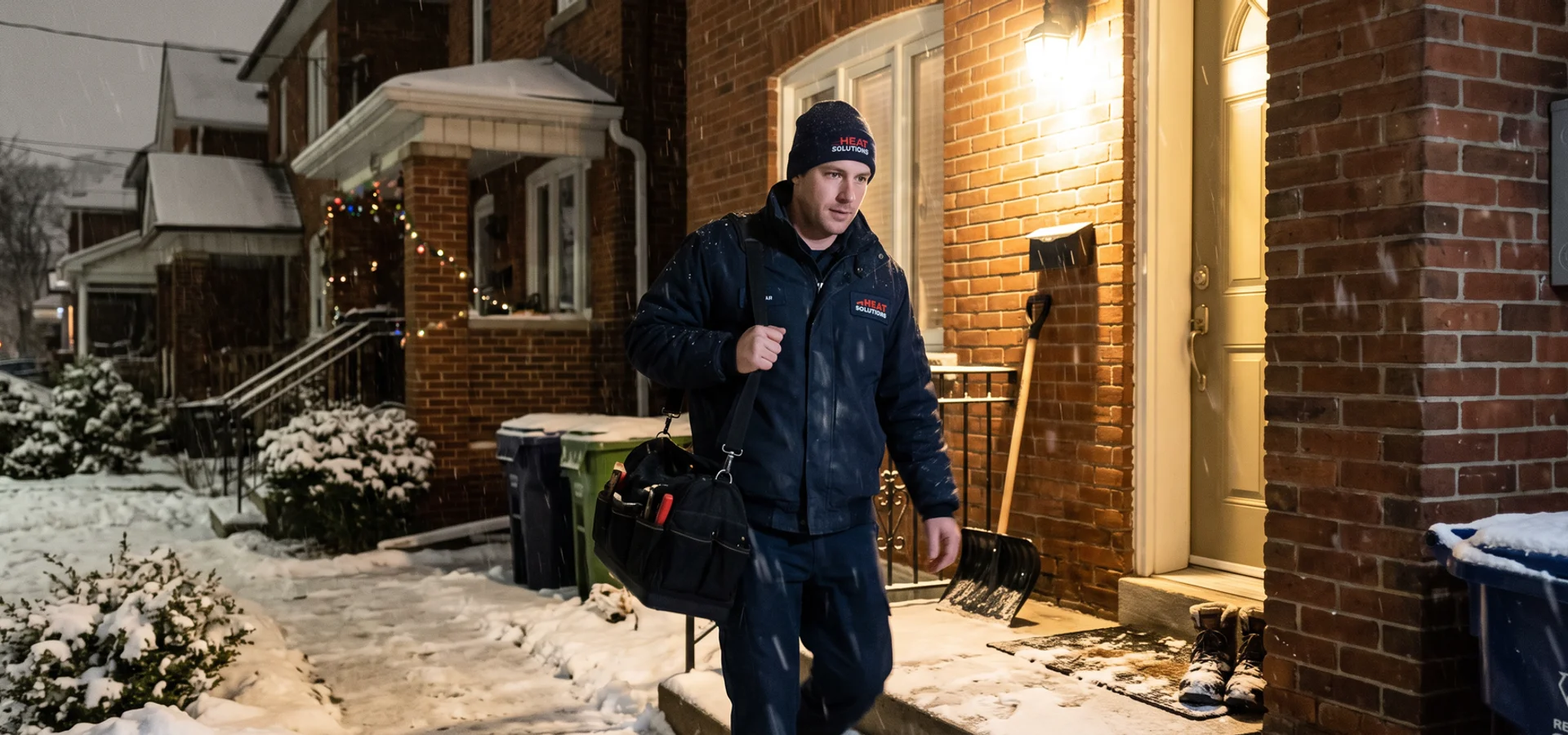
Best Furnace Repair Toronto provides 24/7 emergency furnace repair in Toronto and across the GTA, with TSSA G1/G2 licensed gas technicians and 20+ years of no-heat calls behind every dispatch. Cold-snap no-heat calls are prioritised inside a 4-hour window, and the after-hours diagnostic is quoted in CAD before the van leaves.
When the vents go quiet on a freezing January night, the house starts losing heat straight away and the first question is how fast someone can get there. The Best Furnace Repair crew answers that call every winter, from Etobicoke to Scarborough.
This page walks through exactly what happens on an after-hours call: the warning signs that justify one, what the technician checks, what it costs, and when a repair turns into a replacement conversation.
What Is Emergency Furnace Repair in Toronto?
Emergency furnace repair in Toronto is same-day, after-hours diagnosis and repair of a gas furnace that has stopped producing heat. This critical service is carried out by a TSSA G1 or G2 licensed gas technician under the Ontario B149.1 fuel code. We cover serious faults like hard ignition lockouts, flame rectification failures, high-limit switch trips, and blower motor failures.
A fast response is essential to prevent freezing during cold weather. Our after-hours emergency diagnostic runs $199 to $299 CAD. This fee is waived when you authorise the repair on the same visit, and cold-snap no-heat calls are prioritised inside a 4-hour window across Toronto, North York, Scarborough, Etobicoke, and Vaughan, so the nearest licensed technician to you is the one dispatched.
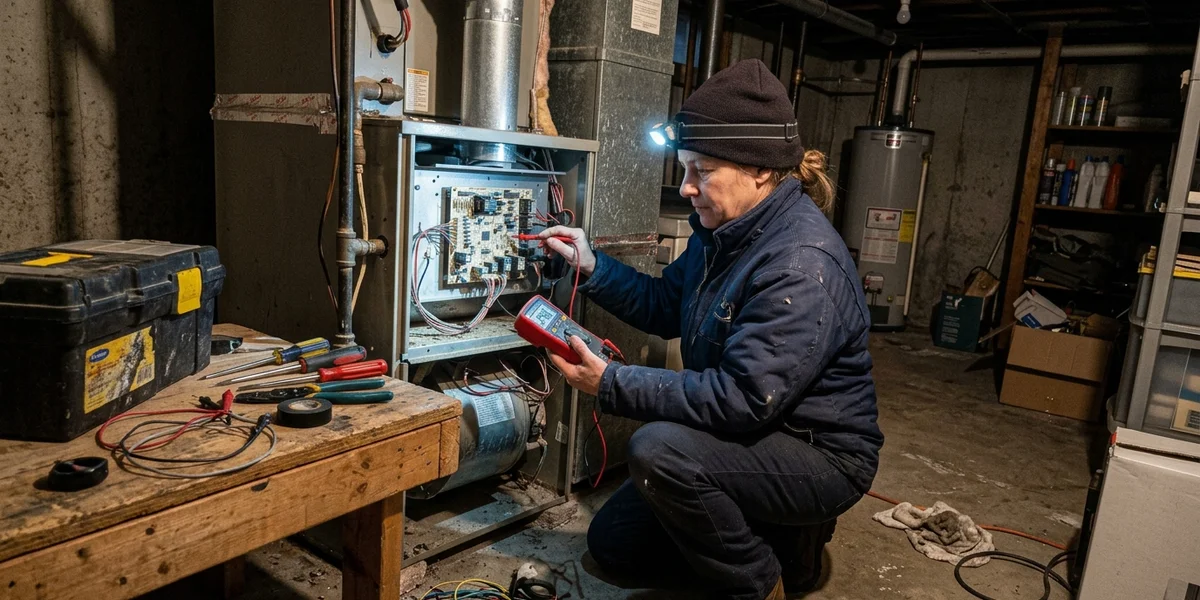
The urgency of the situation is what matters most, rather than the complexity of the breakdown. A majority of emergency calls turn out to be ordinary faults happening at a terrible time. We often find and fix common issues immediately, because these standard replacement parts ride right on the van for immediate use:
- Cracked hot surface ignitors
- Oxide-coated flame sensors
- Failed 24-volt transformers
- Frozen condensate lines
What makes the situation an emergency is the outdoor temperature and the severe risk of frozen water pipes. Our technicians are manufacturer certified for Lennox, Carrier, Trane, Goodman, Napoleon, York, Rheem, and Bryant, and the vans carry universal White-Rodgers controls alongside those brands’ common failure parts. Toronto January nights regularly fall below -20°C with wind chill, which is why a dead furnace cannot wait until morning.
5 Signs You Need Emergency Furnace Repair Tonight, Not Tomorrow
Recognizing a true heating emergency can save your plumbing and keep your family safe. Many modern control boards will flash a red LED fault code to indicate a problem. We always recommend checking these warning signs before trying to push through a freezing night. A quick assessment helps determine if immediate professional help is required.
- No heat with an outdoor temperature below freezing. An average Toronto detached or semi-detached home will lose roughly 1 to 2 degrees Celsius of interior temperature per hour once the furnace stops. Once the inside drops below 10 degrees, pipes in exterior walls, crawl spaces, and unheated basements are at extreme risk of bursting, which is a common winter call in the older brick semis of Leslieville, East York, and The Junction. For landlords, Toronto’s heating bylaw (Municipal Code Chapter 497) requires rental units, including basement apartments, to be kept at a minimum of 21°C from September 15 to June 1.
- The furnace locks out and will not restart. Three failed ignition attempts will put most modern furnaces into a hard ignition lockout mode. Repeated manual resets simply push unburned gas through the combustion chamber, which is highly dangerous.
- A burning smell, soot near vents, or a CO alarm activation. You must shut off the furnace immediately if you notice these signs. We treat this as a serious combustion or heat exchanger problem until proven otherwise, requiring a full combustion analysis to clear.
- A loud bang on startup, or grinding and screeching from the blower. Delayed ignition produces a frightening bang as accumulated gas lights all at once. Grinding usually indicates failing bearings or a blower wheel hitting the metal housing, and neither mechanical issue should be ignored overnight.
- Short cycling every two to three minutes. Overheating, starved airflow, or a misreading flame sensor will cause a furnace to start and stop constantly. Our diagnostic process often reveals that short cycling puts immense thermal stress on the heat exchanger, entirely failing to heat your house.
7 Things Our TSSA-Licensed Technicians Check on Every Emergency Call
A proper diagnostic visit requires a methodical approach to ensure nothing is missed. This systematic testing prevents unnecessary parts replacement and guarantees safety. Best Furnace Repair technicians use specialised tools like Fieldpiece combustion analyzers and digital manometers to verify exactly what is failing. Every component is checked against strict manufacturer specifications.
- Thermostat and low-voltage circuit. Testing the call for heat, verifying the C-wire presence, and checking the 24-volt transformer are the first steps before opening any panels.
- Ignition system. Our technicians measure the hot surface ignitor resistance, check spark or pilot operation, and verify flame rectification current. A healthy flame sensor should typically read between 1.5 to 4 microamps.
- Safety switches. We inspect the roll-out switch, high-limit switch, and the differential pressure switch to determine whether a tripped switch is the actual fault or simply a symptom of a blocked airflow problem.
- Blower motor and airflow. Assessing the ECM or PSC motor operation, run capacitor microfarad readings, and blower wheel cleanliness is vital for safe performance, alongside static duct pressure testing.
- Gas supply and manifold pressure. We check the inlet pressure and manifold pressure using a digital manometer to confirm proper gas valve operation across all heating stages.
- Combustion and venting. A thorough combustion analysis with a CO monitor ensures exhaust gases are safely leaving the home. Checking the flue draft, clearing frozen condensate lines, and knocking ice and snow off side-wall PVC intake and exhaust terminations are standard procedures on high-efficiency condensing units after a Toronto snowfall.
- Heat exchanger integrity. We perform a visual and specialised camera inspection whenever the diagnostic readings point to a potential crack. Carbon monoxide leaks are a primary safety hazard that must be identified quickly.
When Does the After-Hours Diagnostic Fee Get Waived?
Transparency in pricing is something every homeowner deserves during a stressful breakdown. An after-hours emergency diagnostic costs between $199 and $299 CAD (2026 rates). We charge $99 to $149 CAD for the exact same diagnostic during standard business hours. Either fee is waived entirely when you authorise the repair on the same visit.
You get to keep the detailed written fault report regardless of what you decide. This transparent structure exists to solve a very specific problem in the HVAC industry. We hate seeing a straightforward $250 CAD ignitor replacement suddenly turn into a $450 CAD evening bill just because it happened at night. Publishing these scope bands upfront and waiving the diagnostic on authorization removes the terrible guesswork from a stressful situation.
| Fault found | Typical CAD range | Typical time on site |
|---|---|---|
| Ignitor, flame sensor, capacitor | $150 to $450 | 60 to 90 minutes |
| Ignition control module | $300 to $650 | 90 minutes |
| Blower motor (ECM or PSC) | $450 to $950 | 2 to 3 hours |
| Heat exchanger | $600 to $1,500 | 3 to 5 hours, usually scheduled |
How Our Emergency Calls Compare
| What you get on a no-heat call | Typical provider | Best Furnace Repair Toronto |
|---|---|---|
| After-hours diagnostic price | Often quoted on arrival | $199 to $299 CAD quoted before dispatch, waived on same-visit repair |
| Cold-snap response | Next available slot | No-heat calls prioritised inside a 4-hour window |
| Technician licensing | Not always stated | TSSA G1/G2 only, certificate numbers on the invoice, no apprentices sent alone |
| Safety check before leaving | Not always documented | Combustion analysis and CO reading recorded on the service record |
| Common failure parts | Second visit often needed | Ignitors, flame sensors, capacitors, pressure and limit switches carried on the van |
Should a Failed Furnace Be Repaired or Replaced Tonight?
Sometimes an emergency service call ends with a written recommendation to replace the unit rather than fixing it. This is the honest answer when a furnace is well past the 15 to 20-year average lifespan in Ontario and suffers a cracked heat exchanger. We also suggest replacement when a repair bill approaches half the cost of a new high-efficiency system. The long-term efficiency savings often make upgrading the smartest financial move.
Keeping the House Warm Until the New Unit Goes In
If replacing the unit is the safest and most economical choice, keeping your home warm overnight becomes the immediate priority. We provide all the numbers in writing so you can make an informed decision without feeling rushed. A fast turnaround is important, so the installation team schedules emergency replacements within 24 hours where equipment and access allow, whether that is a basement furnace in a Scarborough bungalow or a closet unit in a Markham townhouse.
Ontario Rebates on an Emergency Replacement
If replacement is the right call, we also help you check eligibility for the Enbridge Home Efficiency Rebate Plus (up to $6,500 CAD) and the Canada Greener Homes Grant (up to $5,000 CAD) on qualifying installations, and we file the paperwork on your behalf as an ENERGY STAR certified installer.
For the full breakdown of scope bands, coverage, and how the diagnostic works across every emergency furnace repair Toronto service we run, see furnace repair Toronto.
If the fault is ignition related, furnace ignition repair covers the specifics, and heat exchanger repair covers the CO safety side.